

AI in Computer Vision Market Size to Reach USD 77.69 Billion by 2032 from USD 19.43 Billion in 2024
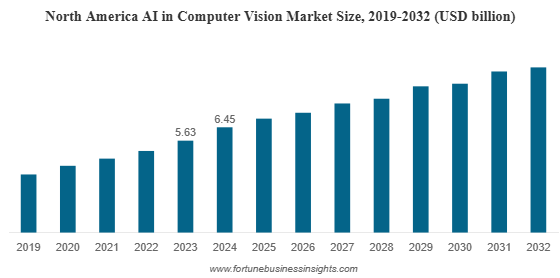
AI in Computer Vision Market Size
AI in Computer Vision Market Size, Growth Drivers, Application Trends, and Industry Outlook 2025–2032
Increased Availability of Visual Data Drives Market Growth”
PUNE, MAHARASHTRA, INDIA, February 10, 2026 /EINPresswire.com/ -- The global AI in Computer Vision Market — a transformative segment within the broader artificial intelligence landscape — is witnessing rapid expansion as vision-enabled automation, image analytics, and machine perception technologies become strategic imperatives across industries. According to Fortune Business Insights, the global AI in computer vision market was valued at approximately USD 19.43 billion in 2024 and is forecast to grow to USD 77.69 billion by 2032, reflecting a substantial compound annual growth rate (CAGR) of 19.10 % during the 2025–2032 period.— Fortune Business Insights
Computer vision — a subfield of AI that enables machines to interpret and understand visual information from the world — has evolved from a niche research domain into a mainstream enterprise technology. Modern systems powered by deep learning, convolutional neural networks (CNNs), and generative AI are now capable of recognizing objects, analyzing scenes, detecting anomalies, and performing real-time tracking with high accuracy. These capabilities are reshaping operations in automotive, healthcare, retail, manufacturing, security, and beyond.
Request a Sample PDF: https://www.fortunebusinessinsights.com/enquiry/request-sample-pdf/ai-in-computer-vision-market-114800
Market Dynamics and Growth Drivers
AI-enabled computer vision technologies are fueling a wave of innovation as organizations integrate visual intelligence into business processes to enhance decision-making, improve operational efficiencies, and deliver differentiated customer experiences. The market’s growth is underpinned by a combination of technological advancements, increasing visual data availability, and demand for automation across sectors.
Key Growth Drivers Include:
• Proliferation of Visual Data: The exponential increase in digital imagery and video content — generated by cameras, sensors, drones, smartphones, and IoT devices — is accelerating the adoption of AI computer vision solutions that can process and extract actionable insights from vast visual datasets.
• Technological Advancements in AI Hardware and Algorithms: Rapid evolution of AI hardware accelerators such as GPUs, AI-specific chips, and edge compute devices is enabling more efficient model training and real-time vision processing. Simultaneously, advancements in deep learning architectures enhance accuracy, reliability, and scalability of vision systems.
• Automation Imperatives in Industry: Across manufacturing, logistics, and quality assurance, businesses are implementing computer vision systems to automate visual inspection, ensure consistency in production, minimize defects, and reduce operational costs — driving demand for AI-enabled vision analytics.
• Rise of Autonomous Systems: Self-driving vehicles, robotic automation, and drones depend heavily on computer vision for navigation, object detection, and environment interpretation. These high-growth applications are significant contributors to market demand.
• Healthcare & Diagnostic Innovation: In healthcare, AI in computer vision is enhancing medical imaging analysis, disease detection, and patient monitoring, enabling earlier diagnosis and improved clinical outcomes.
Despite the market’s strong momentum, significant challenges remain, such as the high computational cost of deployment, integration complexity, and the need for data privacy and security safeguards in sensitive applications.
Market Segmentation Analysis
The AI in computer vision market can be segmented by component, technology, industry vertical, and region — each reflecting unique demand dynamics and strategic adoption patterns.
1. By Component:
• Hardware: Includes imaging sensors, GPUs, AI accelerators, cameras, and edge computing devices necessary to support real-time image and video analytics. These components are critical to achieving high-performance visual intelligence and remain significant revenue contributors.
• Software: Comprises algorithms, vision analytics platforms, model training frameworks, and application software that enable computer vision capabilities such as object detection, facial recognition, and scene understanding. Software advancements are driving broader adoption of vision use cases.
2. By Technology:
AI in computer vision leverages multiple AI technologies including deep learning, machine learning, neural networks, and generative AI models. Deep learning — particularly convolutional neural networks — remains a cornerstone for many vision applications due to its superior pattern recognition capabilities.
3. By Industry Vertical:
• Automotive: Computer vision plays a crucial role in advanced driver assistance systems (ADAS), autonomous vehicles, and traffic monitoring, making automotive a high-growth vertical.
• Healthcare: Applications such as medical image analysis, pathology detection, and clinical diagnostics are driving vision adoption in healthcare.
• Retail & E-Commerce: Retailers use computer vision for customer analytics, inventory tracking, checkout automation, and personalized shopping experiences.
• Manufacturing & Quality Assurance: Vision systems provide real-time inspection and defect detection, improving production efficiencies and reducing waste.
• Security & Surveillance: Computer vision enhances security operations through facial recognition, anomaly detection, and real-time monitoring in public spaces.
Across these verticals, AI-enabled vision technologies are increasingly integrated with other digital solutions — such as IoT, robotics, and cloud analytics — to deliver comprehensive automation and intelligence.
Regional Market Performance
The AI in computer vision market demonstrates distinct regional growth patterns influenced by technological investment, industry adoption, and regulatory frameworks.
North America leads the global market, driven by early adoption of AI technologies, advanced research ecosystems, and strong presence of leading technology vendors. The region’s robust AI infrastructure and innovation capabilities support rapid commercialization of vision systems across automotive, healthcare, and tech sectors.
Europe follows with significant investment in smart manufacturing, autonomous systems, and healthcare analytics — areas where computer vision delivers measurable value. Regulatory emphasis on AI ethics, privacy, and responsible use also shapes adoption strategies in the region.
The Asia Pacific region is poised for substantial growth thanks to escalating digital transformation across China, Japan, India, and Southeast Asian economies. Rising demand for AI-driven automation in manufacturing, automotive assembly, and retail fuels market expansion.
Latin America and Middle East & Africa are experiencing gradual adoption, with increasing deployment of vision applications in security, smart cities, and industrial automation.
Competitive Landscape and Key Market Players
While Fortune Business Insights does not provide an exhaustive company list in its summary, the AI in computer vision market includes major global technology players advancing hardware, software, and integrated solutions. Notable participants spurring innovation include NVIDIA Corporation, Microsoft Corporation, Intel Corporation, Alphabet Inc., Amazon.com Inc., and Sony Corporation — companies that invest heavily in AI research, compute infrastructure, and vision platforms to serve multiple industry needs.
These companies focus on expanding product portfolios, enhancing algorithm performance, and forging strategic industry partnerships to maintain competitiveness and drive commercialization of vision technologies.
Request a Sample PDF: https://www.fortunebusinessinsights.com/enquiry/request-sample-pdf/ai-in-computer-vision-market-114800
Ashwin Arora
Fortune Business Insights™ Pvt. Ltd.
+1 833-909-2966
sales@fortunebusinessinsights.com
Legal Disclaimer:
EIN Presswire provides this news content "as is" without warranty of any kind. We do not accept any responsibility or liability for the accuracy, content, images, videos, licenses, completeness, legality, or reliability of the information contained in this article. If you have any complaints or copyright issues related to this article, kindly contact the author above.
