

Connecting payment systems, linking economies
By Massimo Ferrari Minesso, Laura Lebastard and Olga Triay Bagur[1]
Several countries are working to interlink their domestic fast payment systems in order to reduce costs and improve the speed and transparency of cross-border payments. Econometric evidence suggests that countries with interlinked systems trade with each other about 4% more than countries that lack such interlinkages. The trade gains are larger in regions with high cross-border payment costs and for systems that allow the settlement of wholesale transactions.
Introduction
Every day, billions of transactions flow across borders to pay for goods and settle invoices. Yet this movement of money, the invisible backbone of international trade, remains remarkably slow, costly and fragmented.
Sending remittance from Europe to sub-Saharan Africa, for instance, costs on average more than 8% of the total transferred amount. A business in the Western Balkans paying a supplier across the border can face fees ten times higher than they would be for a transfer within the Single Euro Payments Area. And for firms in many parts of Africa, an international transfer can take several days, as it is routed through multiple bank intermediaries (Financial Stability Board, 2020).
These frictions reflect the architecture of the global payment system. Most international transactions flow through chains of correspondent banks – large global institutions that provide settlement services on behalf of local banks. Each intermediary adds costs and delays. In addition, the network has retrenched in recent years – some countries and regions are underserved (Borchert et al., 2024; Rice et al., 2020).
Policymakers have long been aware of these issues and have been working to find solutions by connecting domestic fast payment systems (FPS), payments and settlement networks that can settle transactions within seconds at low cost. These systems already operate in more than 100 jurisdictions and are increasingly linked across borders, reducing reliance on long correspondent banking chains. For example, the Eurosystem is working towards linking its instant payment system – TARGET Instant Payment Settlement (TIPS) – with India's UPI.[2]
But does connecting payment systems have real economic implications? In particular, does it boost trade and, if so, who benefits the most? These questions are highly consequential given the well-documented inefficiencies of cross-border payments relative to domestic ones, and the range of technological and policy solutions currently being explored to address them (Claessens and Rice, 2026). This article presents findings from our recent ECB Working Paper (Ferrari Minesso, Lebastard and Triay Bagur, 2026) that provides an average estimate of cause and effect at the global level.
A fragmented global payment network
We use a unique dataset that maps over 2,000 cross-border payment system connections across more than 150 countries for the period 2021-24 provided by Ferrari Minesso et al. (2025); the data distinguish fast from non-fast links, bilateral from multilateral connections and retail systems from those with wholesale capability, i.e. systems that can process large-value transactions.[3]
Three structural features stand out.
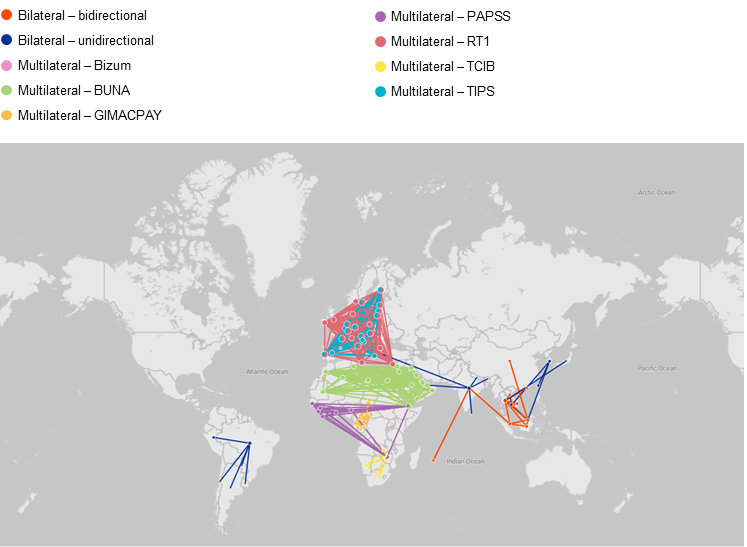
First, the global fast payment network is fragmented into regional blocs that do not communicate with one another (Chart 1).
Second, each bloc is centred on a successful domestic platform – for example, UPI in India or Pix in Brazil – that acts as a hub.
Third, North America remains largely disconnected, leaving correspondent banking as the main channel for most transactions in that region.
Chart 1
Cross-border connections between fast payment systems
Source: Ferrari Minesso et al. (2025).
Notes: The figure shows cross-border connections between FPS in 2024. It shows bilateral connections (split between unidirectional and bidirectional, depending on the currencies used to originate a payment through the link) and multilateral connections (also represented as bilateral connections between country pairs but coloured by regional platform).
Identifying the trade effect
Our work builds on the gravity model (Santos Silva and Tenreyro, 2006) – the standard framework predicting that bilateral trade is proportional to economic size and inversely related to distance and barriers – adding payment connectivity as a new bilateral variable: a dummy equal to one if two countries have interlinked FPS in a given year.
Endogeneity is a critical concern: countries with similar preferences may both trade more and be more likely to link. The paper addresses this with two extensions. The first is a parametric bias-correction method (Carlson and Joshi, 2024), using instruments based on technical characteristics of payment systems, such as shared messaging standards, which influence the ease of interlinking but are unrelated to trade. The second is the synthetic difference-in-differences estimator (Arkhangelsky et al., 2021), which constructs a synthetic control for each treated country pair and identifies the effect from the divergence in trade trajectories after connection.
A quantifiable trade premium
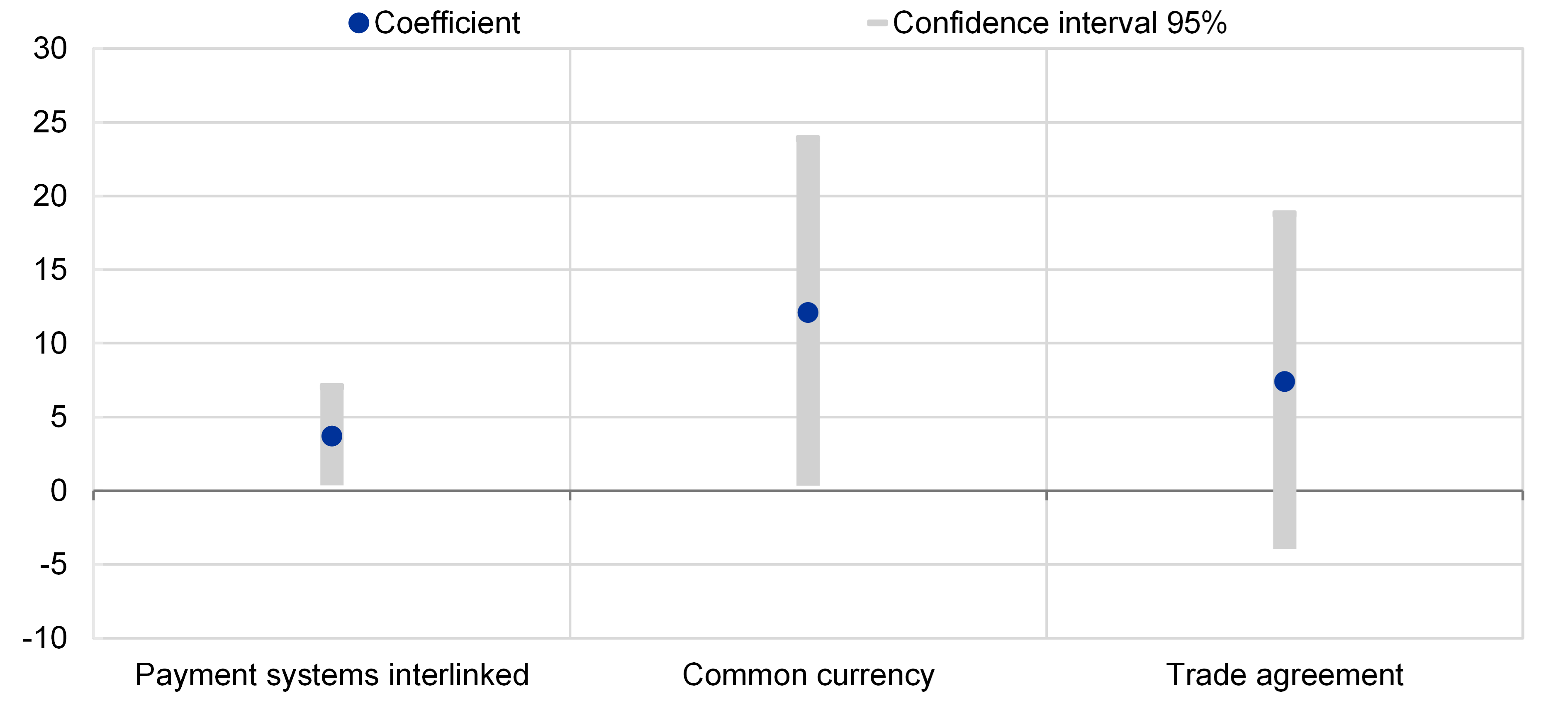
The gravity model shows that countries with interlinked FPS trade approximately 4% more with each other than comparable non-linked pairs, after accounting for all standard determinants of bilateral trade (Chart 2). The significance of the estimate holds across all three methodological approaches, increasing confidence in its robustness.
For comparison, a formal trade agreement is associated with a roughly 5-7% increase in bilateral trade and a common currency with a gain of around 12-16%. Payment connectivity thus delivers an effect about half as large as a trade agreement and a quarter as large as monetary union – a remarkable outcome for what is essentially a technical infrastructure improvement.
Chart 2
Determinants of bilateral exports
(percentages)
Sources: Ferrari Minesso et al. (2026) and ECB staff calculations.
Notes: The chart shows estimates from a gravity model in which potential endogeneity is controlled for using the method in Carlson and Joshi (2024). The regression is specified as . is a dummy equal to one if the FPS of countries i and j are connected at time t. includes the inverse Mills ratio that measures the expected value of the error term conditional on selection. The interlinking dataset covers 84 countries and 531 payment links. The model is estimated on annual data from 2021 to 2024.
Who benefits most?
The 4% estimate is an average across a diverse sample. The benefits are highly heterogeneous, and largest precisely where they are needed most.
Small countries gain significantly more than large ones. Smaller economies are less well-served by correspondent banking: global banks have less incentive to maintain relationships where transaction volumes do not justify the compliance costs. For these countries, a fast payment link is not an add-on but a genuine alternative to expensive and unreliable channels.
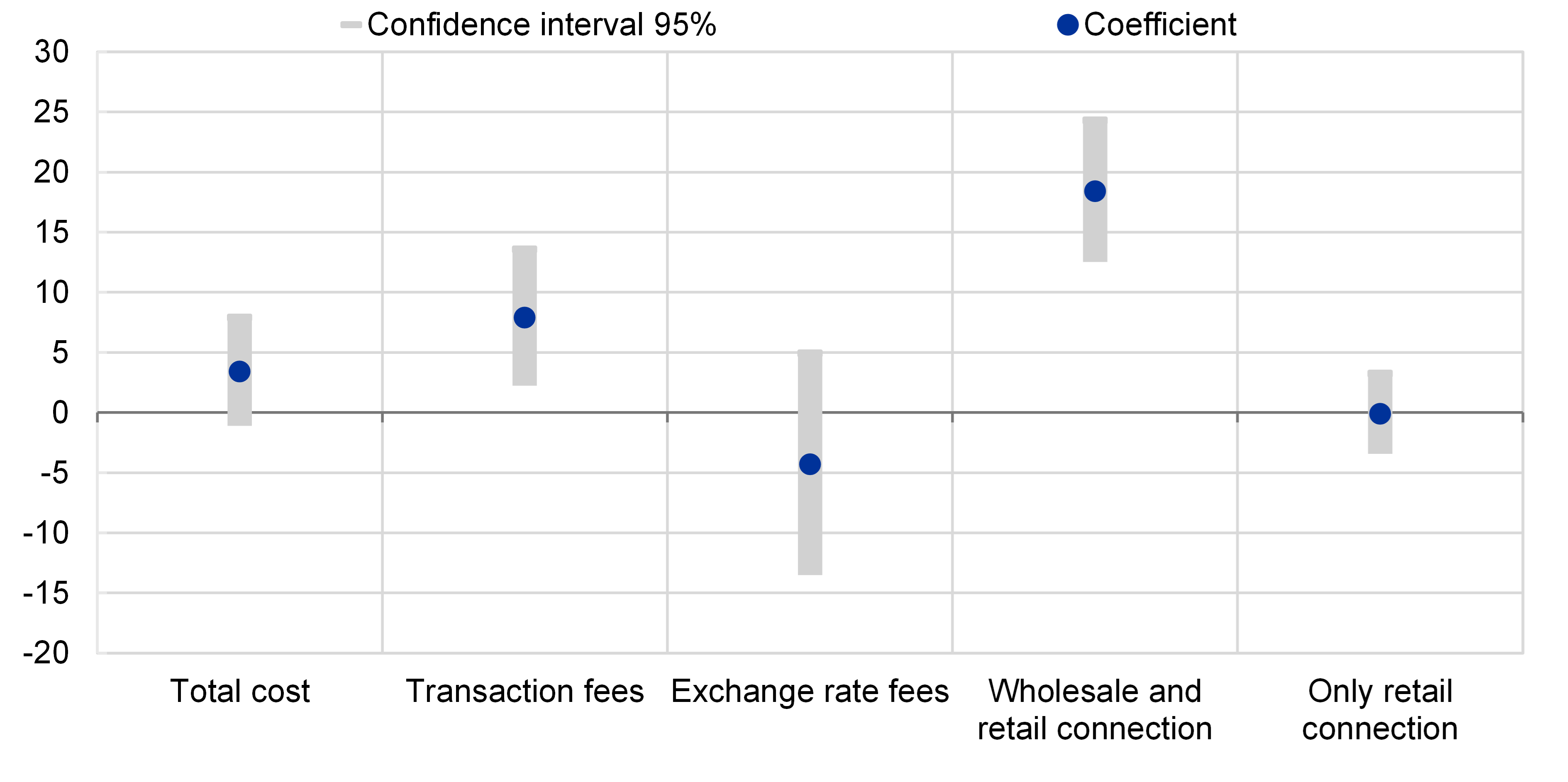
Countries in regions with the highest cross-border payment costs, notably Africa and parts of the Middle East, see the largest gains (Chart 3). More precisely, the effect is stronger in regions where transaction fees are larger. Instead, because interlinking payment systems does not affect the FX settlement layer of cross-border transactions, exchange rate fees do not matter materially.
Finally, links across FPSs that support wholesale transactions, not just retail, generate significantly larger gains (Chart 3). Indeed, most international trade transactions are settled through large-value payments, while retail transactions matter more for other types of cross-border flows, such as personal remittances.
Chart 3
Effect on exports by type of payment system and cost reduction
Percentages
Sources: Ferrari Minesso et al. (2026) and ECB staff calculations.
Notes: The chart reports estimates from an augmented version of the equation used in Chart B. In the two columns on the left, the dummy for payment systems interlinking is divided between those systems that allow only retail settlement and those that allow both retail and wholesale settlement. The three columns on the right report the interaction coefficient of the interlinking dummy and measures of business-to-business cross-border payment costs in the region of the country of origin.
Conclusions and policy implications
Our research findings are directly relevant to policy.
First, they provide empirical validation for the G20 Roadmap for Enhancing Cross-border Payments, which has made FPS interlinkage a strategic priority; the quantifiable trade premium confirms the investments are economically justified.
Second, not all connections affect trade in the same way: the projects that generate the largest trade gains are those that allow wholesale capabilities and extend connectivity to underserved countries. This is intuitive as trade involves large-value transactions typically channelled through payment systems that allow high-value payments. The same conclusion might not hold if the dependent variable were welfare. In this case, the volume and costs of remittances – which are in essence low-value payments – would be more important.
Third, technical standardisation matters. Many existing obstacles are technical: incompatible messaging standards, different settlement assets, unaligned regulation requirements. Common standards such as ISO 20022, already embraced in the Eurosystem’s TARGET services, substantially lower the cost of new links, as already highlighted by Bindseil and Panteloupolos (2022). A push for interoperability standards at the multilateral level, analogous to the World Trade Organization’s role in goods trade, could yield significant welfare gains.
References
Arkhangelsky, D., Athey, S., Hirshberg, D. A., Imbens, G. W. and Wager, S. (2021), “Synthetic difference-in-differences”, American Economic Review, Vol. 111, No 12: pp. 4088-4118.
Bindseil, U. and Pantelopoulos, G. (2022) “Towards the holy grail of cross-border payments”, Working Paper Series, No 2693, ECB.
Borchert, L., De Haas, R., Kirschenmann, K. and Schultz, A. (2024), “The impact of de-risking by correspondent banks on international trade”, VoxEU, 18 September..
Carlson, A. and Joshi, R. (2024), “Sample selection in linear panel data models with heterogeneous coefficients”, Journal of Applied Econometrics, Vol. 39, No 2, March: pp. 237-255.
Claessens, S. and Rice, T. (2026), “Cross-border payment technologies, innovations, and challenges: Lessons from domestic and cross-border payments”, VoxEU, 17 April.
Ferrari Minesso, M., Lebastard, L. and Triay Bagur, O. (2026), “Interlinking payment systems and trade flows”, Working Paper Series, No 3202, ECB.
Ferrari Minesso, M., Mehl, A., Triay Bagur, O. and Vansteenkiste, I. (2025), “Geopolitics and Global Interlinking of Fast Payment Systems”, CEPR Discussion Papers, No 20105, Centre for Economic Policy Research, April.
Financial Stability Board (2020), “Enhancing Cross-border Payments: Stage 3 roadmap”, October.
Rice, T., von Peter, G. and Boar, C. (2020), “On the global retreat of correspondent banks”, BIS Quarterly Review, Bank for International Settlements, March.
Santos Silva, J. M. C. and Tenreyro, S. (2006), “The log of gravity”, Review of Economics and Statistics, Vol. 88, No 4: pp. 641-658.
Legal Disclaimer:
EIN Presswire provides this news content "as is" without warranty of any kind. We do not accept any responsibility or liability for the accuracy, content, images, videos, licenses, completeness, legality, or reliability of the information contained in this article. If you have any complaints or copyright issues related to this article, kindly contact the author above.
